In the modern logistics business, accuracy and efficiency are key factors for success. At Zammler Kazakhstan, we always strive to implement advanced technologies, and automated GPS flight tracking has become one of these solutions.
Problem
Zammler Kazakhstan dispatchers worked in two programs simultaneously:
- Tracked the route in Wialon
- We manually entered warehouse arrival times and checkpoint times into the Zammler Hub ERP.
Constantly switching between systems was time-consuming and increased the risk of errors, slowing response to route deviations.
Integration of the two programs was necessary to reduce the workload on dispatchers. Our company turned to a long-standing Wialon partner – UMT, a Ukrainian telematics provider. The UMT Connector service he developed helps efficiently manage routes in transport logistics.
Solution
To automate the dispatch service, we needed to combine two data streams – from Wialon and the Zammler Hub ERP.
The Zammler Kazakhstan fleet was already equipped with GPS trackers and connected to Wialon. Therefore, the first step was fine-tuning the system, specifically adjusting geofences. The UMT provider updated their list—warehouses, delivery points, and checkpoints—and edited the boundaries based on actual truck parking and stops. This created the basis for accurately recording trip completions.
The next step was installing and configuring UMT Connector, a service that connected Wialon to Zammler Hub and automated the transfer of trip data.
How does it work?
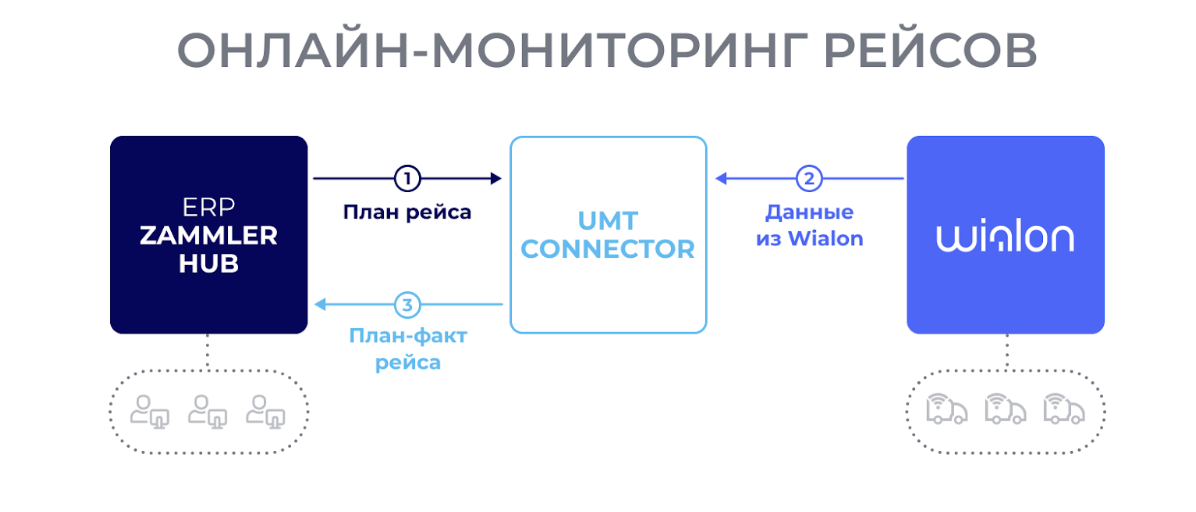
The UMT Connector service transfers data between the company’s ERP system and Wialon for online flight monitoring.
UMT Connector receives a flight plan from Zammler Hub, namely:
- Flight number
- Vehicle number
- Route
- Loading and unloading points, as well as checkpoints
- Time window and sequence of visits
- Date and time of the start and end of the trip
When a truck departs for a trip, the service tracks its movement via Wialon and records the actual data. All data processing occurs on the UMT Connector side, and in the Zammler Hub, dispatchers immediately see the information they need:
- Trip status
- Actual route, unloading points, and checkpoints
- Trip time and duration
- Link to the vehicle’s track via the Wialon “Locator” tool
Now Zammler Hub automatically monitors route execution and generates reports. If any deviations occur, the system immediately notifies the responsible dispatcher or logistics specialist.
The telematics service provider not only linked two independent data streams using UMT Connector but also defined the logic for processing them. This proved to be the project’s main challenge: creating a flexible system capable of accounting for non-standard route situations when interpreting Wialon data.
“It was necessary to anticipate force majeure events: vehicle derailments, vehicle replacements, route cancellations, and much more. Thanks to our many years of experience in automating transport logistics and the well-coordinated teamwork, we were able to find solutions that cover all possible route scenarios,” UMT explained.
Result

Andrey Perepelitsa,
CEO of Zammler Kazakhstan
“We are pleased with the initial results and will continue to automate cargo transportation to provide our customers with the best service.”
Dispatch service automation
Dispatchers no longer need to switch between different programs and enter data on completed flights. Now, schedule compliance is monitored automatically and in real time directly in the company’s ERP system – faster and more reliably than manually.
Improved customer service quality
“Optimizing flight control fits into our ongoing process of improving customer service,” says Andrey Perepelitsa. “This helps ensure on-time delivery of goods, reduce transit times, and respond more quickly if there is a route deviation.”
Improved analytics to reduce costs
Zammler Kazakhstan notes that analytics on completed trips has become faster and more accurate: “We track the on-time delivery to each point, trip times, loading and unloading times, and other key indicators. This helps us find affordable ways to reduce costs in transport logistics, such as reducing excess mileage.”
Automated GPS tracking has allowed us to make logistics even more reliable, accurate, and efficient. We continue to develop technologies to ensure our customers receive the best service and predictable delivery times.