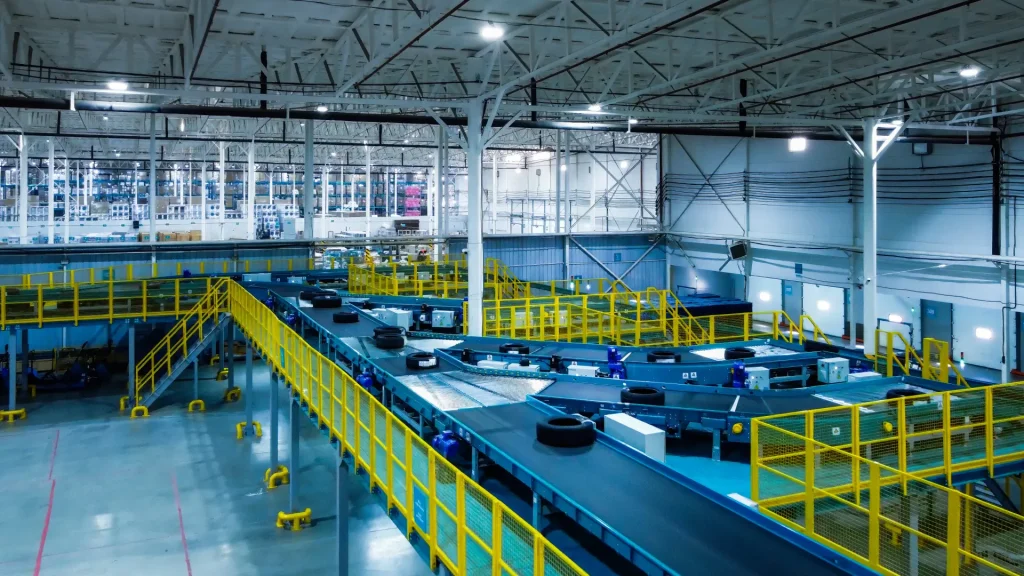
Any large sorting hub operates on the same principle: the main line handles the primary flow, while anything non-standard in shape, size, or weight is diverted for manual processing.
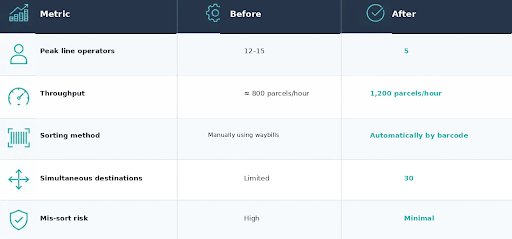
At the Zammler Kazakhstan hub in Almaty, this non-standard flow consisted of parcels that could not pass through the main sorting system: items of unusual shape—round, soft, or containing magnetic elements. All of these parcels were diverted from the main line and sorted manually, with operators using waybills to route parcels by destination. During peak periods, 12–15 people worked in this area, processing around 800–1,000 parcels per hour. This became the target area for automation.
System Design
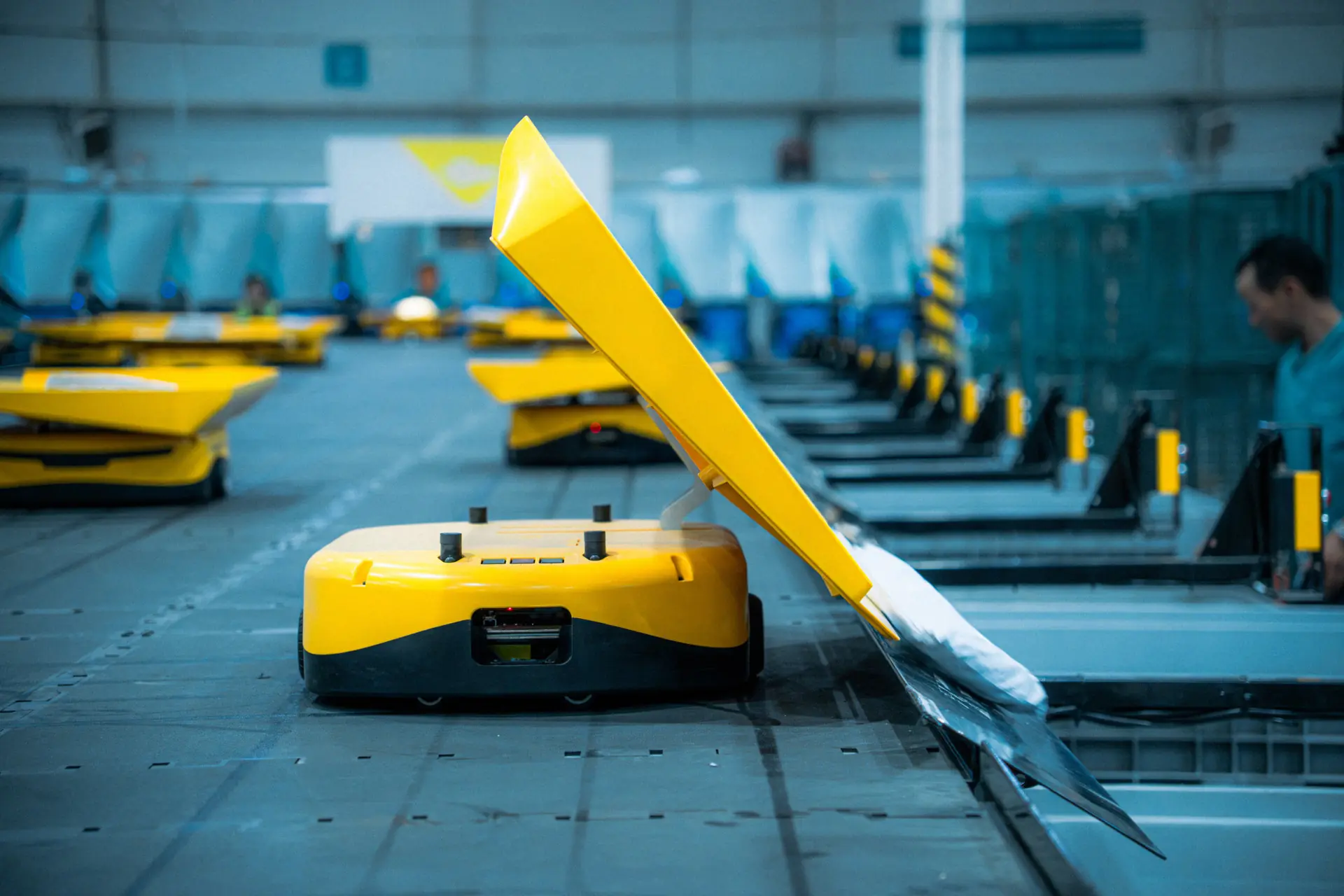
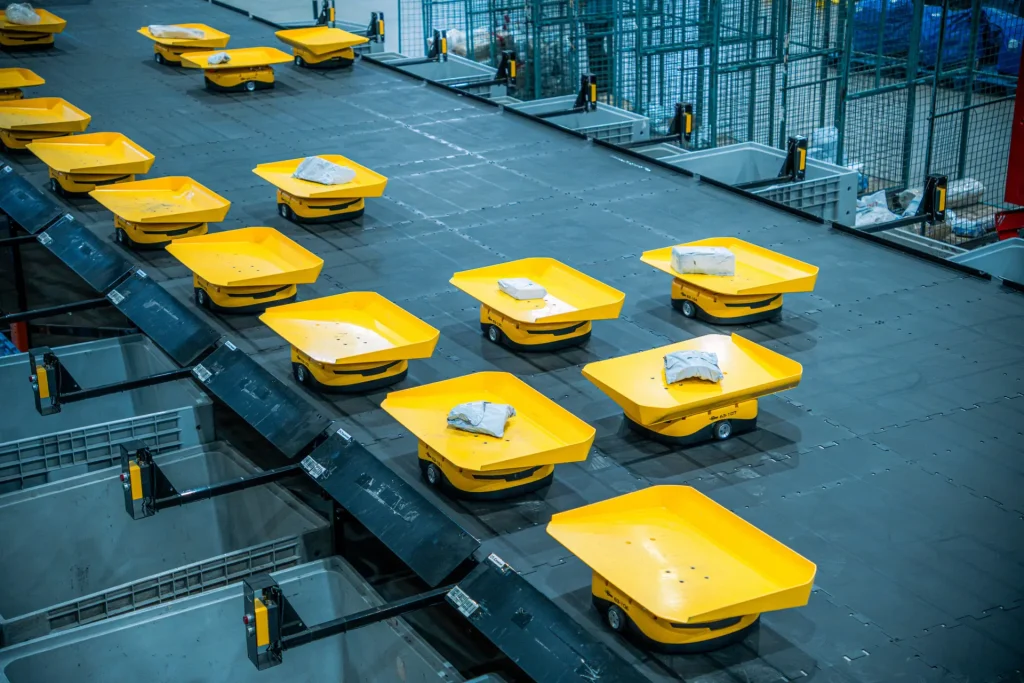
The robotic line is built around 17 autonomous sorting robots. Parcels are identified by two overhead scanners: the barcode is read as each parcel enters the system, without any additional action from the operator. The entire line is integrated with the hub’s internal system.
Process Logic:
Parcels that are non-standard for the main line are brought to an operator, who places each one in a tray. The system reads the barcode from above, identifies the parcel, and sends the robot a task specifying which port the shipment should be delivered to. The robot picks up the tray and carries the parcel to the required discharge port, one of 30 available destinations. At the destination, the parcel is automatically dropped into the chute. No repeat scan is needed to route the parcel onward—the line handles this automatically.
If a robot’s battery runs low, it autonomously travels to the charging station and, once fully charged, returns to the line without operator involvement.
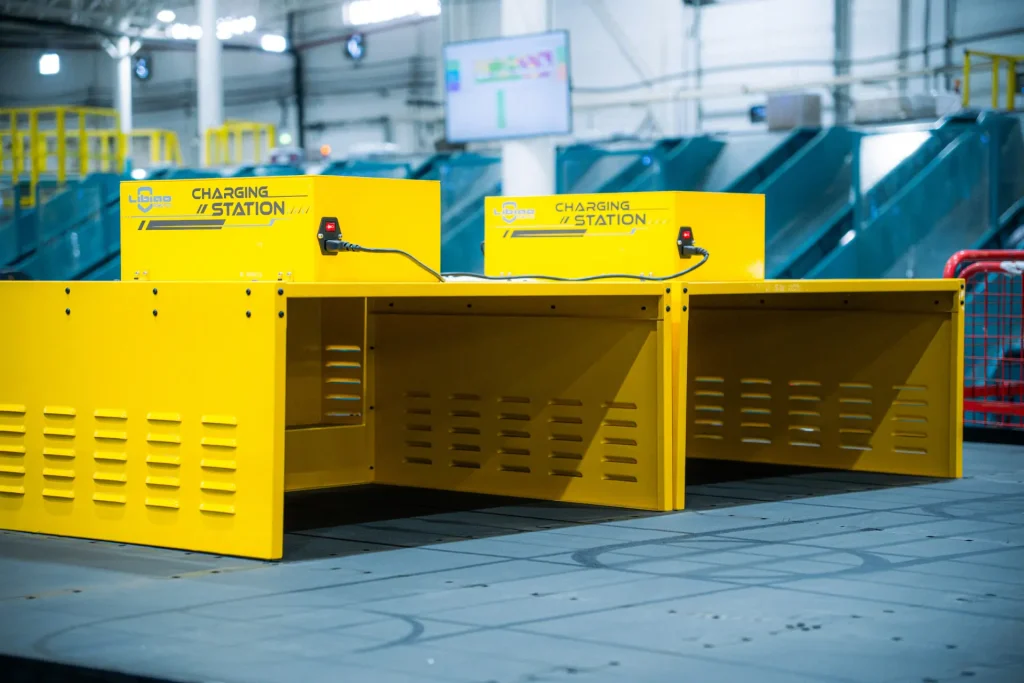
Charging Station
Technical Specifications of the Line:
- 17 sorting robots
- 30 discharge ports / destinations;
- 2 scanners in the system;
- maximum parcel dimensions: width 50–60 cm, height up to 50 cm;
- maximum weight: 15 kg;
- current throughput: 1,200 parcels per hour;
- design capacity: up to 2,000 parcels per hour.
What Changed
The transition to robotic sorting changed two parameters at the same time—staffing levels and processing quality.
People
Instead of 12–15 operators, 5 employees are now assigned to the sorting system. Their task is to feed parcels onto the line. Repeat scanning to route an order is no longer required: the line determines the route automatically during the initial scan. This is a fundamentally different type of work—fewer repetitive operations and a lower probability of error.
Accuracy
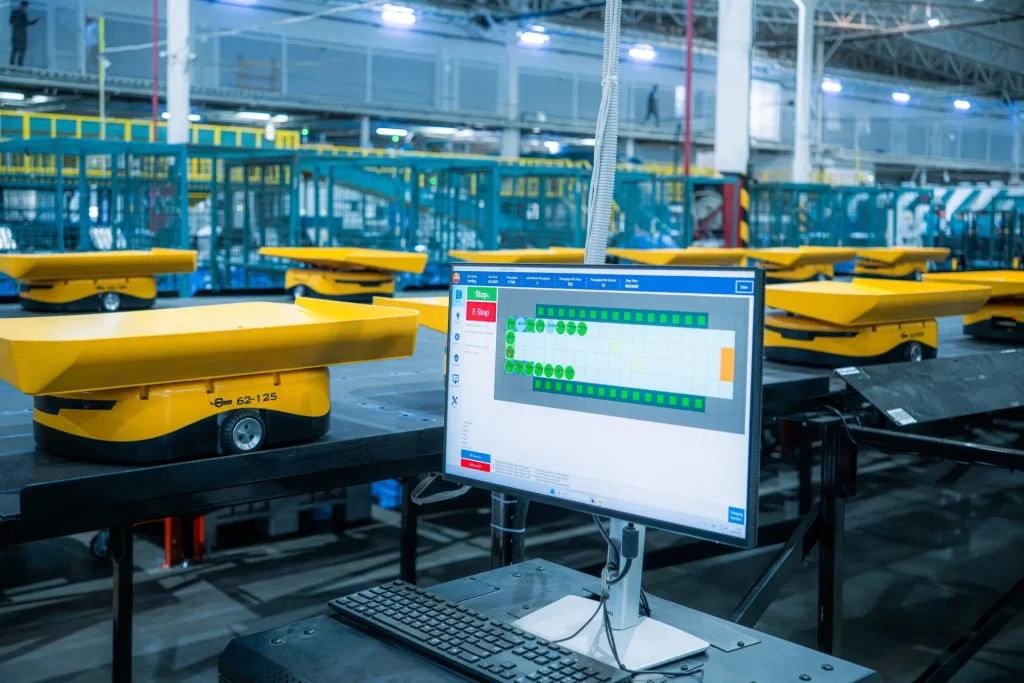
With manual sorting, the likelihood of a mis-sort or routing error depends directly on shift workload and the operator’s condition, and it increases significantly during peak periods. Robotic sorting removes this dependency: every parcel is processed according to the same algorithm regardless of flow intensity. The system scans the barcode, determines the destination, and delivers the shipment accurately.
Economics and Scale
The robotic line can be scaled without structural changes to the operating model: volume growth does not require a proportional increase in staffing in this area. With a design capacity of 2,000 parcels per hour, the system provides a capacity buffer that can absorb peak loads without additional personnel.
Before and After:
Outlook
The current throughput of 1,200 parcels per hour is the operating rate, not the limit. The system’s design capacity is 2,000 parcels per hour. As the hub’s cargo turnover grows, the system can handle an increase in peak load of up to 40% without any structural changes to the line.

 Copy link